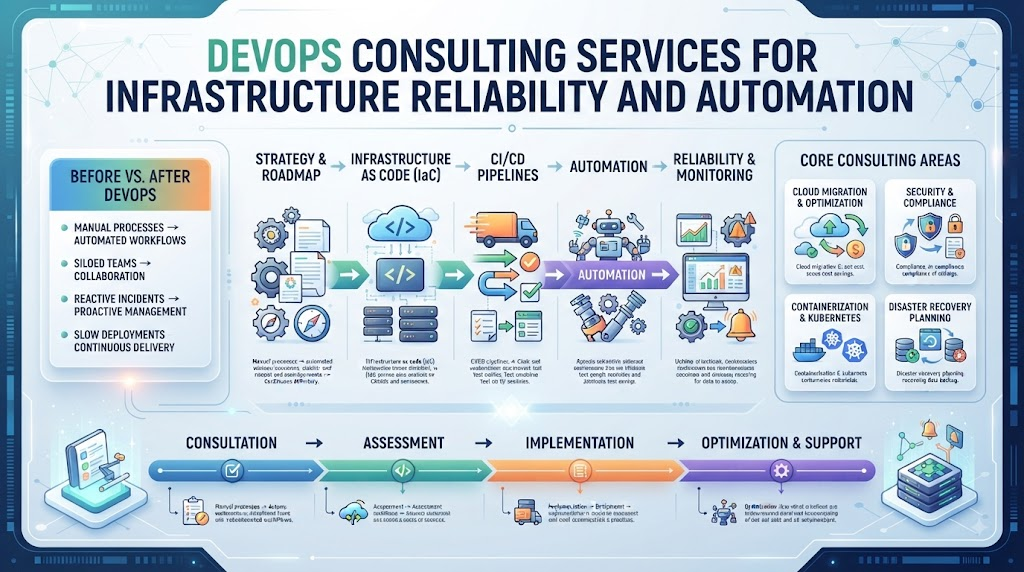
As digital products grow, engineering teams often face a new set of challenges. Deployments become more frequent, cloud environments become harder to control, infrastructure expands across multiple services, and production issues require faster responses. At the same time, developers need simpler workflows and security teams need stronger controls.DevOps Consulting Services help organizations bring these areas together through better automation, delivery practices, infrastructure management, observability, security, and reliability engineering.The purpose is not to add more tools. It is to reduce friction across the software lifecycle and create systems that are easier to deploy, operate, and improve.
DevOps Consulting Starts with the Current Environment
Every organization begins from a different technical position. Some teams may still depend on manual deployments, while others may already use CI/CD, cloud platforms, and Kubernetes but struggle with scale and governance.
A DevOps consultant typically reviews areas such as:
- Build and deployment processes
- Infrastructure provisioning
- Cloud architecture
- Monitoring and alerting
- Security controls
- Container platforms
- Incident management
- Developer workflows
- Infrastructure ownership
This assessment helps identify where automation or architectural changes can deliver the most practical value.
Automation as the Foundation
Automation is one of the strongest elements of modern DevOps.Instead of provisioning infrastructure manually, teams can use Infrastructure as Code with technologies such as Terraform or CloudFormation. Instead of deploying applications manually, CI/CD pipelines can automate building, testing, validation, and deployment.Automation can also be introduced into configuration management, security scanning, monitoring, backup processes, and infrastructure validation.The objective is consistency. Repetitive tasks should become predictable and easier to maintain.
Managed DevOps for Operational Support
Managed DevOps Services can support organizations that need continuous assistance with infrastructure and software delivery.
These services may include:
- Pipeline administration
- Deployment support
- Infrastructure monitoring
- Cloud maintenance
- Incident handling
- Configuration updates
- Infrastructure automation
- Environment management
Managed services can be useful for teams that want to concentrate on product engineering while receiving additional operational support.However, technical ownership should remain clear. Documentation, infrastructure code, architecture decisions, and operational knowledge should remain accessible to the internal team.
AWS DevOps and Cloud Automation
AWS DevOps Consulting Services help organizations apply DevOps practices to workloads running on Amazon Web Services.Depending on workload needs, teams may use EC2, ECS, EKS, Lambda, CloudFormation, Terraform, and CI/CD technologies.For example, a containerized application might run on ECS or EKS, while an event-driven workload may use Lambda. Infrastructure can be defined through code, and deployments can be automated through delivery pipelines.There is no single AWS architecture that suits every application. Decisions should depend on factors such as operational complexity, scalability, security, cost visibility, and team capabilities.
Security Integrated into Delivery
Modern engineering teams cannot treat security as a final review before release.DevSecOps Consulting Services help integrate security throughout development, testing, deployment, and operations.
Common practices include:
- Static application security testing
- Dynamic application security testing
- Dependency checks
- Secrets management
- Container scanning
- Vulnerability management
- Infrastructure security validation
- CI/CD security gates
This approach allows teams to identify many security concerns earlier and make security part of routine engineering work.
Kubernetes as an Operational Platform
Kubernetes can help standardize containerized workloads, but production operations often require specialized knowledge.Kubernetes Consulting Services may support:
- Cluster architecture
- Application deployment
- Networking
- Access control
- Security
- Scaling
- Monitoring
- Cluster upgrades
- Resource management
Organizations may operate Kubernetes using AWS EKS, Azure AKS, or Google GKE.The important question is not simply whether Kubernetes can be adopted, but whether it creates enough operational value to justify its complexity.
Cloud Migration as a Modernization Opportunity
Cloud migration is most valuable when it improves the way infrastructure is managed, not only where applications are hosted.Cloud Migration Services India can combine migration planning with DevOps automation.A migration project may include application assessment, dependency analysis, target architecture design, infrastructure automation, security planning, testing, cutover, monitoring, and post-migration optimization.Moving to the cloud can also provide an opportunity to replace manual infrastructure practices with repeatable automation and stronger operational standards.
Platform Engineering for Developer Efficiency
Development teams frequently lose time dealing with repeated infrastructure and deployment tasks.Platform Engineering Consulting Services focus on creating reusable internal capabilities that simplify these activities.
An internal platform may provide:
- Self-service infrastructure
- Deployment templates
- Developer portals
- Predefined CI/CD workflows
- Standard cloud environments
- Security policies
- Observability integrations
- Golden paths
Instead of every team creating its own deployment process, developers can use standardized services maintained by a platform team.This can reduce duplication and improve consistency across engineering environments.
SRE and Reliability Management
Site Reliability Engineering provides a structured method for managing application reliability.SRE Consulting Services may help teams define Service Level Indicators, Service Level Objectives, error budgets, monitoring standards, incident processes, and capacity planning.SRE also encourages teams to reduce repetitive operational effort through automation.For example, recurring manual recovery tasks can be reviewed and converted into automated procedures where appropriate.This creates a healthier balance between feature development and operational stability.
DevOps Outsourcing for Flexible Engineering Capacity
DevOps Outsourcing Services can be useful when organizations require additional expertise for a limited project or ongoing operations.
Common use cases include:
- Cloud transformation
- CI/CD implementation
- Kubernetes management
- DevSecOps adoption
- Infrastructure automation
- Monitoring improvements
- Production support
Organizations considering outsourcing should evaluate communication, security, documentation, technical ownership, support processes, and knowledge transfer.External expertise should strengthen internal capabilities rather than make the organization dependent on outside teams for basic operational knowledge.
Core DevOps Areas
| Area | Main Purpose |
|---|---|
| CI/CD | Automate software delivery |
| Infrastructure as Code | Create repeatable environments |
| Cloud Engineering | Manage scalable infrastructure |
| DevSecOps | Integrate security into delivery |
| Kubernetes | Operate container workloads |
| Observability | Improve system visibility |
| Platform Engineering | Simplify developer operations |
| SRE | Improve service reliability |
Common Mistakes to Avoid
DevOps initiatives often fail when teams focus too heavily on technology and not enough on process.Common mistakes include automating inefficient workflows, introducing unnecessary complexity, ignoring documentation, neglecting security, creating unclear ownership, and adopting tools without understanding operational requirements.Another common issue is weak observability. Automation is useful only when teams can understand what happens after software reaches production.A mature DevOps model should therefore combine automation with ownership, documentation, monitoring, security, and continuous improvement.
Selecting the Right Consulting Approach
Organizations evaluating a DevOps Consulting Company India should focus on practical capability.
Important areas include:
- Cloud engineering knowledge
- Infrastructure automation skills
- CI/CD experience
- Kubernetes expertise
- DevSecOps understanding
- SRE capability
- Documentation standards
- Communication
- Knowledge transfer
- Long-term maintainability
The best consulting approach is not necessarily the one with the largest technology stack. It is the one that fits the existing environment and solves meaningful engineering problems.
Conclusion
DevOps consulting helps organizations improve the complete software delivery lifecycle, from infrastructure and deployment to security, monitoring, developer experience, and reliability.Automation can reduce manual effort, DevSecOps can make security more continuous, Kubernetes can improve container operations, platform engineering can simplify development workflows, and SRE can introduce measurable reliability practices.Organizations should adopt these practices according to their engineering maturity and operational requirements rather than following trends.