Introduction
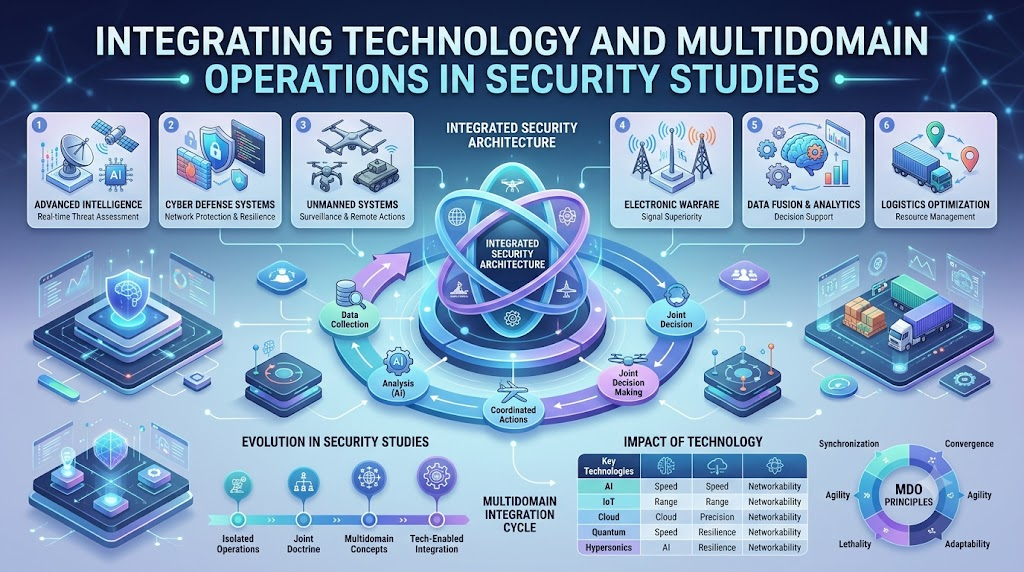
How do modern defense organizations coordinate actions across traditional battlefields, outer space, and digital networks simultaneously? As military strategy evolves beyond traditional domain boundaries, defense analysts and students must understand how modern armed forces integrate actions across land, maritime, air, space, and cyber environments. Multidomain Operations represents an organizational and strategic framework designed to synchronize capabilities across these distinct realms to achieve strategic objectives. Understanding this framework requires examining how leadership, logistics, command and control systems, and intelligence work together. This article explores the conceptual foundations, historical context, organizational structures, and strategic challenges of multidomain integration, providing researchers and policy learners with a foundation in defense studies at WarOpsX.
Understanding Multidomain Operations
Core Principles and Terminology
Multidomain Operations (MDO) refers to the strategic and operational orchestration of capabilities across physical, digital, and cognitive operational environments. Rather than viewing warfare through isolated services—such as army ground forces, naval fleets, or air corps—MDO emphasizes rapid cross-domain synchronization.
- Domain: A distinct operational medium characterized by unique physical or technical properties (Land, Maritime, Air, Space, and Cyber).
- Cross-Domain Synergy: The complementary application of capabilities from one domain to create advantages in another, preventing adversaries from isolating a single branch or asset.
- Convergence: The deliberate integration of capabilities across time, space, and virtual environments to achieve specific strategic outcomes.
In defense studies, MDO moves beyond simple cooperation among service branches. It requires interoperable technologies, unified command structures, and shared situational awareness across all operating environments.
The Evolution from Joint Warfare
During the 20th century, military organizational structures relied on the concept of “joint warfare”—cooperation between ground, naval, and air forces. Major conflicts demonstrated that air support was critical for ground forces, while naval forces secured maritime supply corridors essential for sustainment.
By the late Cold War, doctrines such as AirLand Battle formalized synchronization between land forces and tactical air support. However, modern defense environments include two additional domains: space and cyber. Satellites now provide global positioning, communication, and environmental sensing, while digital networks host critical command infrastructure. As reliance on information networks increased, defense theorists expanded joint warfare principles into multidomain operations.
The Five Primary Domains of Modern Strategy
                          ┌───────────────────────────┐
                          │   Multidomain Operations  │
                          └─────────────┬─────────────┘
                                        │
      ┌───────────────┬─────────────────┼─────────────────┬───────────────┐
      │               │                 │                 │               │
┌─────┴─────┐   ┌─────┴─────┐     ┌─────┴─────┐     ┌─────┴─────┐   ┌─────┴─────┐
│    Land   │   │  Maritime │     │    Air    │     │   Space   │   │   Cyber   │
│ Environment│   │ Environment│     │ Environment│     │ Environment│   │ Environment│
└───────────┘   └───────────┘     └───────────┘     └───────────┘   └───────────┘
Land, Air, and Maritime Domains
The three traditional physical domains remain central to territorial defense and geopolitical stability:
- Land Domain: Focuses on terrain, geographic positions, and population centers. Ground forces manage territorial control, infrastructure protection, and civil stability.
- Maritime Domain: Covers oceans, coastal waters, and sea lines of communication. Naval systems secure maritime commerce, conduct sea control, and project logistics over long distances.
- Air Domain: Encompasses atmospheric airspace. Air systems provide rapid mobility, broad surveillance, and aerial deterrence.
Each domain features distinct operational tempos, physical constraints, and logistical support structures.
Space and Cyber Domains
The non-traditional domains operate across global boundaries and often lack fixed geographic borders:
- Space Domain: Encompasses orbital platforms, global positioning architectures, early-warning sensors, and satellite communications. Space assets serve as the backbone for global navigation and strategic surveillance.
- Cyber Domain: Consists of digital hardware, software networks, processing data, and communications infrastructure. Cyber capabilities focus on securing friendly information systems while maintaining network resilience under adverse conditions.
The Information Environment
Overlapping all five domains is the information environment. This realm involves human decision-making, cognitive processing, public communications, and electronic signatures. Modern defense technology focuses heavily on managing information flow to prevent data overload and maintain accurate situational awareness for strategic leaders.
Command, Control, and Intelligence Integration
Command and Control Systems in Synchronized Operations
Command and Control Systems (C2) provide the organizational frameworks through which leaders assess situations, make decisions, and issue orders. In a multidomain context, C2 systems must integrate vast streams of data from disparate military organizational structures.
Key challenges in multidomain C2 include:
- Interoperability: Ensuring communications hardware and software across ground, naval, air, space, and cyber components can share data securely.
- Decision Velocity: Processing incoming observations rapidly so strategic leaders can make informed decisions faster than an opposing organization can adapt.
- Resilience: Maintaining operational networks even when specific communication channels or satellite links experience interference.
Intelligence, Surveillance, and Reconnaissance (ISR)
Intelligence, Surveillance, and Reconnaissance (ISR) forms the foundation of multidomain awareness. ISR is divided into three functional concepts:
- Intelligence: The synthesis and analysis of collected data to understand systemic context, operational environments, and potential risks.
- Surveillance: The systematic, ongoing observation of specific geographic areas, orbital slots, or digital networks over extended timeframes.
- Reconnaissance: Focused tasks executed to obtain specific information regarding terrain, environmental conditions, or targeted system positions.
Modern defense technology uses autonomous systems, distributed sensors, and advanced computational tools to fuse ISR data into a unified operational picture.
Logistics and Organizational Structure
Military Logistics and Sustainment Challenges
Military logistics forms the backbone of multidomain operations. Without robust supply chains and sustainment networks, complex strategic plans cannot function. Multidomain logistics involves:
- Supply Chain Visibility: Tracking fuel, munitions, medical supplies, and spare parts across land, sea, and air transport corridors.
- Infrastructure Maintenance: Protecting physical seaports, airfields, rail networks, and digital logistics management databases.
- Distribution Management: Balancing heavy transport capacity (maritime and rail) with high-speed delivery options (cargo aircraft and tactical transport).
Modern sustainment planners must address vulnerable supply corridors, ensuring that logistics networks remain resilient under logistical disruptions or cyber interruptions.
Military Organizational Structure and Cross-Domain Coordination
To support multidomain operations, military organizational structures must adapt away from isolated service silos toward integrated command organizations.
| Organizational Level | Primary Strategic Function | Scope of Multidomain Integration |
| Strategic Leadership | Establishes national defense policy, resource allocation, and long-term security goals. | Balances military capabilities with economic, diplomatic, and technological resources. |
| Operational Command | Coordinates campaigns, allocates operational assets, and manages joint geographic areas. | Synchronizes land, sea, air, space, and cyber forces toward unified regional objectives. |
| Tactical Formation | Executes specific operational tasks using formations, units, and localized equipment. | Implements direct cross-domain tools, such as using satellite ISR to support ground movements. |
Comparative Domain Analysis
| Domain | Primary Operational Medium | Strategic Function | Primary Integration Challenge |
| Land | Terrestrial geography, soil, infrastructure | Territorial presence, infrastructure protection | Physical terrain barriers and slow strategic movement |
| Maritime | Oceans, seas, coastal waterways | Open sea navigation, ocean commerce security | Long transit times and vast geographic coverage |
| Air | Atmospheric airspace | Rapid reach, high-altitude surveillance | Fuel constraints and limited persistent presence |
| Space | Orbital regions above Earth | Global positioning, satellite communications | Orbital mechanics, high launch costs, satellite vulnerability |
| Cyber | Electromagnetic spectrum and network nodes | Digital infrastructure defense, data security | Rapid technological change and attribution complexity |
Historical Context and Practical Scenarios
Example 1: Historical Development of Joint Synchronization (Operation Overlord, 1944)
The Allied invasion of Normandy during World War II represents an early historical example of strategic multi-service synchronization. Success depended on aligning distinct domain elements:
- Maritime: Navies transported hundreds of thousands of personnel and secured ocean channels.
- Air: Air forces maintained air superiority, conducted deep reconnaissance, and interdicted rail infrastructure.
- Land: Ground forces established beachheads and secured territorial footholds.
- Information: Deception campaigns altered strategic perceptions regarding the primary landing locations.
While lacking modern space and cyber capabilities, Operation Overlord illustrated that major campaign success requires coordinating disparate domain forces under a unified command structure.
Example 2: The Transition from AirLand Battle to Digital Integration
During the 1980s, military strategy emphasized the AirLand Battle doctrine to counter large armored formations in Europe. This approach integrated army ground maneuvers with air force interdiction strikes, relying on synchronized timing and radio communications.
With the advent of satellite navigation, digital data links, and global fiber-optic networks in the 1990s and 2000s, defense analysts recognized that air-land integration alone was insufficient. The rapid growth of internet communications and space assets transformed doctrine from two-domain coordination into five-domain multidomain operations.
Example 3: Hypothetical Defense Scenario — Multi-Domain Disaster Response
Note: The following scenario is a hypothetical conceptual example designed to illustrate organizational coordination.
Consider a international humanitarian crisis resulting from a severe natural disaster affecting an archipelagic region:
- Space Domain: Satellites provide initial damage mapping and restore global positioning signals.
- Cyber Domain: Technicians secure digital relief registries and restore civilian communications networks.
- Air Domain: Cargo transport planes drop emergency supplies and transport medical personnel.
- Maritime Domain: Hospital ships and amphibious vessels provide off-shore power generation and fresh water.
- Land Domain: Engineering units clear roads, repair port facilities, and distribute medical supplies.
This hypothetical scenario illustrates how multidomain coordination applies equal utility to civil defense, disaster relief, and strategic stability operations.
Strategic Analysis Framework
Students and researchers can apply this step-by-step framework to analyze any military strategy or defense system:
- Step 1: Define the Strategic Objective: Identify the primary policy or security goal the defense organization seeks to achieve.
- Step 2: Identify Operating Domains: Determine which mediums (land, sea, air, space, cyber) are relevant to the strategic problem.
- Step 3: Analyze Organizational Structures: Review command relationships, service responsibilities, and leadership hierarchies involved.
- Step 4: Evaluate Command & Control (C2) Systems: Assess how information flows between sensors, command headquarters, and operational units.
- Step 5: Examine Logistics and Sustainment: Identify supply routes, maintenance needs, fuel requirements, and infrastructure dependencies.
- Step 6: Assess Technology and Interoperability: Determine whether communications, data networks, and hardware can share information seamlessly.
- Step 7: Identify Systemic Risks: Evaluate potential friction points, such as communication failures, supply bottlenecks, or information overload.
- Step 8: Consider Policy and Legal Context: Review international laws, civil-military relations, and national policy constraints affecting the organization.
Common Misconceptions in Defense Studies
1. Multidomain Operations Are Merely Advanced Technology
A common error is treating MDO solely as a collection of high-tech sensors, artificial intelligence, or satellite systems. In reality, multidomain operations is primarily an organizational, doctrinal, and leadership concept. Technology enables cross-domain synchronization, but strategic doctrine, training, and human decision-making govern its success.
2. Space and Cyber Replace Physical Ground Presence
While space platforms and cyber networks provide global reach, they do not render physical ground or maritime forces obsolete. Security, human governance, and geographic terrain control require physical presence on land and sea. Non-physical domains support and enhance physical operations rather than replacing them.
3. More Information Automatically Leads to Better Decisions
In military strategy, acquiring more data does not automatically improve leadership decisions. Defense organizations often face information overload, where command headquarters receive vast quantities of raw ISR data without the processing capacity to analyze it efficiently. Effective command systems focus on information quality, relevance, and rapid synthesis.
4. Strategy, Operations, and Tactics Are the Same Thing
Defense studies strictly separates these three levels of activity:
- Strategy: Defines long-term national security goals, policy, and resource allocation.
- Operational Art: Coordinates campaigns and major joint maneuvers to achieve strategic objectives within a theater.
- Tactics: Focuses on the specific arrangements, movements, and techniques of individual units and systems during immediate tasks.
Frequently Asked Questions
What is Multidomain Operations (MDO)?
Multidomain Operations is an educational and strategic framework focused on synchronizing capabilities across land, maritime, air, space, and cyber environments. Rather than operating each military branch independently, MDO integrates forces to solve complex strategic problems across physical and digital domains simultaneously.
How does MDO differ from traditional joint operations?
Traditional joint operations primarily emphasized cooperation between physical forces: land armies, navies, and air forces. Multidomain operations expands this joint concept to treat cyber networks, outer space platforms, and the information environment as co-equal operational domains requiring continuous integration.
What is the role of space in multidomain strategy?
The space domain provides global satellite infrastructure essential for positioning, navigation, timing, atmospheric monitoring, and early-warning communications. Modern defense systems rely on space assets to connect command elements with remote units and maintain global situational awareness.
Why is command and control (C2) critical in modern defense systems?
Command and control systems allow strategic leaders to collect information, make decisions, and issue guidance. In multidomain environments, C2 systems must integrate massive amounts of incoming data from diverse platforms while maintaining network security under adverse conditions.
What is the distinction between strategy and tactics?
Strategy focuses on long-term national objectives, policy considerations, and resource management across an entire organization. Tactics refers to the specific methods, unit formations, and localized tasks performed by individual units in the field to achieve immediate goals.
How does cyber technology affect defense studies?
Cyber capabilities affect digital hardware, software networks, and data transmission systems. In security studies, cyber analysis focuses on protecting critical infrastructure, maintaining secure command networks, ensuring data integrity, and understanding digital network resilience.
What is Intelligence, Surveillance, and Reconnaissance (ISR)?
ISR combines three distinct activities: intelligence (analyzing context and data), surveillance (continuous observation of regions or networks), and reconnaissance (focused tasks to collect specific information). Together, they provide strategic decision-makers with clear situational awareness.
Why is military logistics crucial to strategic planning?
Military logistics manages the transportation, fuel distribution, maintenance, medical care, and material sustainment required to keep large organizations operating. A strategy that exceeds its logistical capacity cannot sustain operations over extended periods, regardless of its technological sophistication.
How do organizational structures adapt to multidomain requirements?
Organizations adapt by creating integrated joint headquarters, establishing standardized communication protocols, and training leaders to understand capabilities outside their primary service branch. This minimizes service silos and improves decision velocity across all domains.
Where can students find reputable defense studies resources?
Students can explore academic journals, official government policy releases, historical defense archives, and educational platforms like WarOpsX.com to build foundational knowledge regarding military strategy, history, logistics, and organizational structures.
Conclusion
Understanding multidomain operations requires analyzing how strategy, command and control, defense technology, logistics, and organizational structures interact across physical and digital mediums. As land, maritime, air, space, and cyber environments become increasingly interconnected, defense studies must look beyond individual service branches to examine integrated systems as a whole. Historical developments show that strategic success relies on clear decision-making, sound supply chain management, and adaptable leadership rather than technology alone. By studying these high-level strategic concepts, researchers, students, and policy learners build a strong framework for evaluating modern defense environments. Platforms such as WarOpsX.com support this educational journey by providing analytical insights into military history, strategic theory, and organizational readiness for responsible learning.