Introduction
Kubernetes makes it easier to deploy and scale modern applications, but operating large Kubernetes environments can become difficult very quickly. Containers, pods, nodes, services, deployments, logs, metrics, and network dependencies can generate enormous amounts of operational data. Finding the actual cause of an incident among all these signals is not always straightforward.
This is where AIOps for Kubernetes can provide useful operational intelligence. By combining machine learning, observability, event correlation, and automation, teams can analyze Kubernetes data and identify unusual behavior more efficiently. TheAIOps.com provides practical knowledge for professionals exploring Artificial Intelligence for IT Operations, automation, and modern operational practices. This guide explains how AIOps can be applied to Kubernetes, where it provides value, and what teams should consider before introducing automation.
What Is AIOps for Kubernetes?
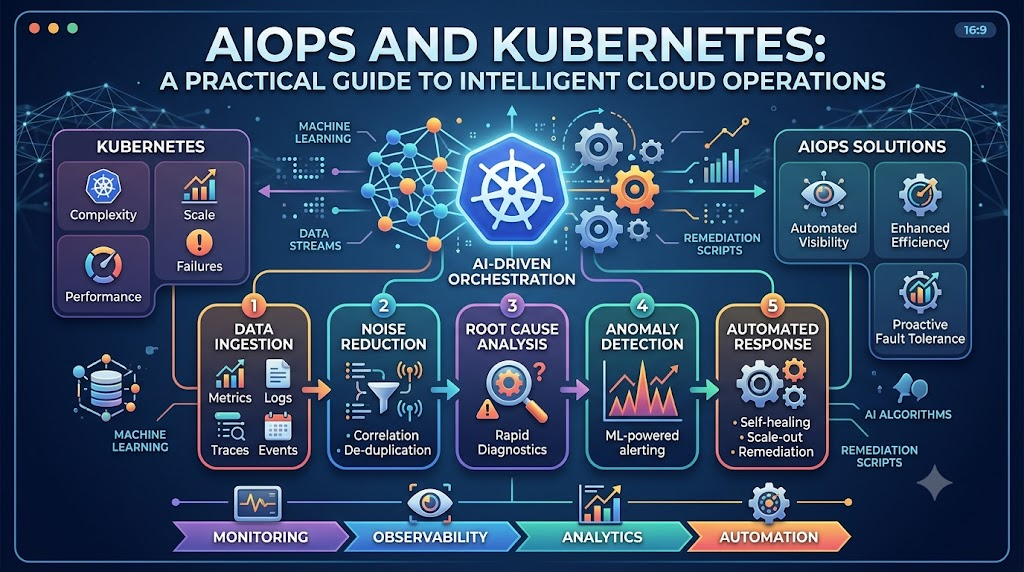
AIOps for Kubernetes means applying Artificial Intelligence for IT Operations techniques to Kubernetes environments. The objective is not simply to collect more monitoring data. Instead, the goal is to turn large amounts of operational telemetry into useful information for engineers.
A Kubernetes environment may produce metrics about CPU and memory usage, logs from applications, events from the Kubernetes control plane, traces across microservices, and information about deployments and infrastructure.
An AIOps Platform can bring these signals together and analyze them for patterns such as unusual resource consumption, repeated failures, service degradation, or relationships between seemingly unrelated events.
For example, a sudden increase in application latency might initially appear to be an application problem. Correlated telemetry could reveal that a Kubernetes node is experiencing memory pressure, causing container instability and eventually affecting the application.
Why Kubernetes Needs Intelligent Operations
Kubernetes environments are highly dynamic. Pods can be created, removed, restarted, or moved between nodes. Applications may scale automatically, while infrastructure and configuration can change through continuous delivery pipelines.
Traditional monitoring remains useful, but static thresholds alone may not provide enough context for complex environments.
AIOps can add capabilities such as:
- Anomaly detection based on changing operational patterns
- Event correlation across multiple services
- Intelligent alert prioritization
- Root-cause analysis
- Predictive analytics
- Incident investigation support
- Automated remediation for selected problems
The purpose is to help engineers spend less time sorting through disconnected signals and more time solving meaningful operational issues.
How AIOps Works with Kubernetes Observability
Collecting Kubernetes Telemetry
A useful AIOps implementation begins with reliable operational data. Depending on the environment, this may include Kubernetes events, container metrics, application logs, distributed traces, node information, deployment events, and infrastructure telemetry.
Observability provides the visibility required to understand what is happening inside the environment.
Metrics can show resource behavior, logs can provide detailed event information, and traces can show how requests move through microservices.
Correlating Events
A single infrastructure problem can generate many alerts.
Suppose a node develops resource pressure. Several pods may restart, application latency may increase, and downstream services may produce timeout errors. A monitoring system may report each symptom independently.
AIOps event correlation can analyze timing, dependencies, topology, and other context to group related events into a more meaningful incident.
Detecting Anomalies
Anomaly detection attempts to identify behavior that differs significantly from an established pattern.
For example, an application might normally consume a relatively stable amount of memory during a particular period. A sudden and unusual increase could trigger investigation even when a traditional fixed threshold has not been crossed.
The quality of anomaly detection depends heavily on the quality and context of the underlying data.
Common AIOps Use Cases in Kubernetes
The following examples show how AIOps capabilities can connect with practical Kubernetes operations.
| AIOps Capability | Kubernetes Signal | Practical Operations Use Case |
|---|---|---|
| Anomaly detection | CPU, memory, latency, restart patterns | Identify unusual application or infrastructure behavior |
| Event correlation | Pod, node, deployment, and service events | Group related alerts into a single incident |
| Root-cause analysis | Metrics, logs, traces, topology | Investigate dependencies behind service degradation |
| Automated remediation | Health checks and operational events | Trigger approved recovery actions for known failures |
Application Performance Monitoring
AIOps can analyze application metrics alongside Kubernetes infrastructure data. This can help teams distinguish between application-level issues and infrastructure-related problems.
For microservices, combining traces with service dependency information can also provide more context during an incident.
Container and Node Monitoring
Resource pressure is a common operational concern in Kubernetes.
AIOps can analyze CPU, memory, disk, network, and restart behavior to identify unusual patterns. Depending on the configuration, these insights can support capacity planning or trigger carefully controlled operational workflows.
Incident Management
When an incident occurs, engineers often need information from several systems.
An AIOps solution can potentially correlate monitoring events with logs, traces, deployment information, and incident-management records. This gives responders more context when investigating the problem.
AIOps and Automated Remediation
Automation is one of the more powerful applications of AIOps, but it should be introduced carefully.
For example, an organization might define a controlled workflow for a known low-risk condition. If a non-critical workload repeatedly fails its health check, an approved automation could restart the affected workload after predefined validation checks.
More sensitive actions should require human approval.
Production database changes, destructive infrastructure operations, major configuration changes, or actions affecting critical services should have appropriate authorization, testing, rollback procedures, and auditability.
AIOps should support engineering judgment rather than blindly execute every recommendation.
Practical AIOps Implementation for Kubernetes
A successful AIOps Implementation can be approached incrementally.
1. Define a Specific Operational Problem
Start with a measurable problem such as excessive Kubernetes alerts, slow incident investigation, or recurring service failures.
2. Assess Existing Observability
Review existing metrics, logs, traces, Kubernetes events, dashboards, and monitoring integrations. Identify important gaps before adding new intelligence.
3. Improve Data Quality
Standardize telemetry where possible. Consistent timestamps, service identifiers, metadata, and correlation information make analysis more useful.
4. Connect Relevant Data Sources
Integrate Kubernetes telemetry with application monitoring, cloud infrastructure, incident management, deployment systems, and other relevant sources.
5. Introduce Correlation and Anomaly Detection
Begin with advisory capabilities. Allow engineers to evaluate whether correlations and anomaly findings are useful before enabling automated actions.
6. Automate Low-Risk Workflows
Once confidence has been established, introduce narrowly defined remediation workflows with clear permissions and rollback mechanisms.
7. Measure and Improve
Track operational indicators such as incident detection time, investigation effort, false positives, automation success, and recurring failure patterns.
Choosing AIOps Tools for Kubernetes
When evaluating AIOps Tools, organizations should look beyond marketing claims. Integration capabilities are particularly important because Kubernetes rarely operates in isolation.
Consider whether a platform supports:
- Kubernetes and cloud integrations
- Logs, metrics, and traces
- Event correlation
- Service topology
- Anomaly detection
- Incident-management integration
- APIs and automation
- Access controls
- Audit trails
- Scalable data ingestion
- Custom workflows
The right choice depends on the organization’s architecture, operational goals, existing technology stack, security requirements, and level of AIOps maturity.
Challenges and Security Considerations
AIOps does not eliminate operational complexity. Poor telemetry can produce weak analysis, while excessive data can increase storage and processing requirements.
Teams may also encounter false positives, incorrect correlations, integration difficulties, and resistance to automated actions.
Security requires particular attention. AIOps systems that can execute Kubernetes actions need carefully controlled permissions. Least-privilege access, audit logging, change management, approval workflows, testing, and rollback procedures should be part of the design.
Automation should never receive broader permissions simply because an operation is convenient.
Skills for an AIOps Engineer
Professionals working with Kubernetes and AIOps often need a combination of skills rather than expertise in only one technology.
An AIOps Engineer may work with Kubernetes, cloud infrastructure, observability, monitoring, automation, incident management, scripting, and data analysis.
For people building these skills, AIOps Training or an AIOps Course can cover areas such as AIOps architecture, observability, anomaly detection, event correlation, automation, and operational workflows. An AIOps Certification may demonstrate knowledge of particular concepts or technologies, although certification requirements and scope vary.
Organizations may also use AIOps Consulting or specialized AIOps Services when they need assistance designing integrations, selecting platforms, or establishing an implementation strategy.
Best Practices for Kubernetes AIOps
A practical approach includes several principles:
- Start with a clearly defined operational problem.
- Establish reliable observability before advanced analytics.
- Keep humans involved in high-impact decisions.
- Test automation outside production first.
- Use least-privilege permissions.
- Monitor automated actions.
- Maintain rollback procedures.
- Review false positives and false negatives.
- Update models and rules as applications change.
- Measure operational outcomes rather than simply counting alerts.
The objective should be useful operational intelligence, not automation for its own sake.
Frequently Asked Questions
1. What is AIOps for Kubernetes?
AIOps for Kubernetes applies AI, machine learning, analytics, observability, and automation techniques to Kubernetes operations. It can help teams analyze telemetry, correlate events, detect anomalies, and investigate incidents.
2. How does AIOps improve Kubernetes monitoring?
It can combine information from Kubernetes, applications, infrastructure, logs, metrics, and traces to provide more context than isolated monitoring alerts.
3. Can AIOps automatically fix Kubernetes problems?
It can support automated remediation for selected, well-understood problems. High-impact production actions should generally have appropriate controls and human oversight.
4. What Kubernetes data is useful for AIOps?
Useful data may include metrics, logs, traces, Kubernetes events, deployment information, node status, pod behavior, service dependencies, and incident records.
5. Is Kubernetes observability required for AIOps?
Strong observability is highly useful because AIOps depends on reliable operational data. Poor or incomplete telemetry can reduce the quality of analysis.
6. Can AIOps reduce Kubernetes alert fatigue?
Event correlation and intelligent alert prioritization can help group related signals and reduce the number of individual alerts engineers need to investigate.
7. What AIOps Tools can work with Kubernetes?
AIOps tools vary considerably. Evaluation should include Kubernetes integration, observability support, event correlation, automation, APIs, scalability, security, and incident-management integration.
8. Is AIOps useful for microservices?
Yes. Microservices can generate complex dependencies and large volumes of telemetry. AIOps can help correlate signals across services and provide additional context during incidents.
9. What should beginners learn before studying AIOps?
A useful foundation includes Linux, networking, cloud concepts, Kubernetes, monitoring, observability, scripting, DevOps practices, and basic data-analysis concepts.
10. What does an AIOps Engineer do?
Responsibilities vary by organization. An AIOps Engineer may design operational-data pipelines, configure AIOps capabilities, integrate monitoring systems, develop automation, investigate anomalies, and improve incident-management workflows.
Conclusion
Kubernetes provides powerful capabilities for running modern applications, but its dynamic nature can create significant operational complexity. AIOps can add intelligence by combining observability data, anomaly detection, event correlation, root-cause analysis, and carefully controlled automation. The strongest implementations begin with reliable telemetry and specific operational goals rather than attempting to automate everything immediately. By combining Kubernetes expertise with observability, automation, and Artificial Intelligence for IT Operations, teams can build a more informed and manageable approach to modern cloud operations.