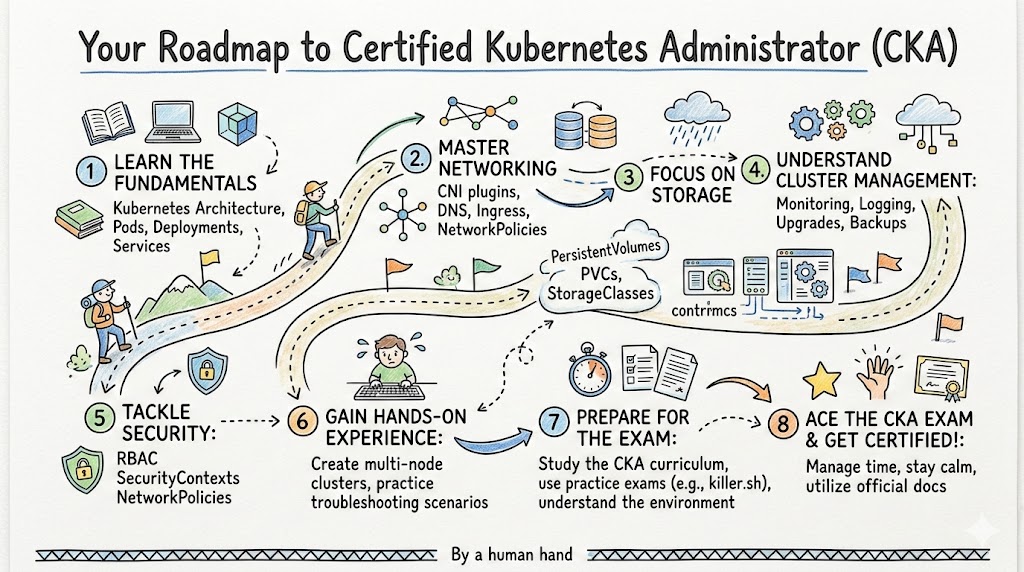
Introduction
As containerization becomes the standard for deploying and managing modern applications, Kubernetes has become the go-to solution for orchestrating containerized workloads and services. With its growing adoption across industries, mastering Kubernetes is essential for professionals in cloud and DevOps roles.
One of the best ways to demonstrate your expertise in Kubernetes is by earning the Certified Kubernetes Administrator (CKA) certification. This certification not only validates your technical skills but also opens doors to career advancement and opportunities in the thriving world of cloud-native technologies. In this guide, we will walk you through the ins and outs of the CKA certification, from what you’ll learn to how you can best prepare for the exam.
What is the Certified Kubernetes Administrator (CKA) Certification?
The Certified Kubernetes Administrator (CKA) certification is an exam created by the Cloud Native Computing Foundation (CNCF) to evaluate your ability to manage Kubernetes clusters. The exam tests your proficiency in a range of Kubernetes tasks, from cluster installation and configuration to scaling, troubleshooting, and securing your environment.
This certification ensures you possess the hands-on skills required to perform critical tasks within Kubernetes ecosystems, making it one of the most important certifications for professionals in DevOps, cloud architecture, and container orchestration.
Who is the CKA Certification For?
The CKA certification is intended for professionals who are responsible for the deployment, management, and operation of Kubernetes clusters. Here are the ideal candidates:
- System Administrators: Who manage Kubernetes clusters, ensuring smooth deployments and cluster health.
- DevOps Engineers: Responsible for automation, CI/CD pipelines, and managing Kubernetes in production.
- Cloud Engineers: Using Kubernetes for scalable, cloud-native applications.
- Platform Engineers: Designing and maintaining platforms using Kubernetes as a container orchestration tool.
- Site Reliability Engineers (SREs): Ensuring high availability, scalability, and reliability of Kubernetes systems in production.
If you are in any of these roles or aspire to enter one, the CKA certification can enhance your career and validate your skills.
Skills You Will Acquire with the CKA Certification
Achieving the CKA certification will equip you with a robust set of skills that are highly valuable in the cloud-native world. The key skills you’ll gain include:
1. Cluster Installation & Configuration
- Learn to set up Kubernetes clusters using various tools like kubeadm or cloud solutions such as Google Kubernetes Engine (GKE) and Amazon EKS.
- Configure nodes, understand the control plane components, and scale your cluster based on the requirements.
2. Managing Kubernetes Applications
- Gain proficiency in deploying, scaling, and managing applications on Kubernetes.
- Learn how to manage application lifecycle, including upgrades and rollbacks, to ensure high availability.
3. Kubernetes Networking
- Master the concepts of Kubernetes networking, including Services, DNS, Ingress controllers, and Load Balancers.
- Set up internal and external access to applications running in Kubernetes clusters.
4. Security & Access Control
- Secure Kubernetes clusters by configuring Role-Based Access Control (RBAC), network policies, and Secrets management.
- Learn how to control access, encrypt communications, and protect sensitive data in your clusters.
5. Troubleshooting & Debugging
- Acquire troubleshooting skills for identifying and resolving issues with pods, nodes, and services using kubectl and logging tools.
- Troubleshoot failed deployments, network issues, and resource constraints.
6. Storage Management
- Learn to manage persistent storage using Persistent Volumes (PV) and Persistent Volume Claims (PVC).
- Understand Storage Classes and dynamic provisioning of storage resources.
Real-World Tasks You’ll Be Equipped to Handle Post-CKA
After obtaining your CKA certification, you will be capable of handling several essential Kubernetes administration tasks, including:
- Cluster Setup: Setting up and managing multi-node clusters in cloud or on-premise environments.
- CI/CD Pipeline Integration: Integrating Kubernetes into CI/CD pipelines to automate deployment and scaling.
- High Availability & Disaster Recovery: Implementing strategies to ensure your Kubernetes environment is both scalable and resilient to failures.
- Security Implementations: Securing Kubernetes resources, managing user access, and implementing encryption for sensitive data.
- Cluster Monitoring & Logging: Setting up monitoring systems such as Prometheus and Grafana, and integrating logging with tools like ELK Stack.
Preparing for the CKA Exam: A Step-by-Step Approach
The CKA exam is a practical, hands-on test, so thorough preparation is key. Here’s a step-by-step plan to guide you through your preparation:
7-14 Days Preparation Plan:
- Day 1-7: Get familiar with Kubernetes basics such as Pods, Deployments, and Services. Install Minikube or use cloud providers to set up a basic cluster.
- Day 8-14: Learn Kubernetes networking concepts like Services and DNS. Deploy sample applications on your local Kubernetes cluster to practice.
30 Days Preparation Plan:
- Day 1-10: Focus on deeper networking concepts and persistent storage management. Learn how to configure Ingress controllers, RBAC, and Persistent Volumes.
- Day 11-20: Study security concepts, including Secrets management, Network Policies, and Role-Based Access Control (RBAC).
- Day 21-30: Practice troubleshooting Kubernetes issues. Take time to work through mock exams and get familiar with exam scenarios.
60 Days Preparation Plan:
- Day 1-20: Study advanced Kubernetes topics, including cluster upgrades, scaling, and troubleshooting.
- Day 21-40: Set up complex applications with persistent storage, security configurations, and networking policies.
- Day 41-60: Take timed mock exams, review the official Kubernetes documentation, and practice solving exam-like tasks within the time limit.
Common Mistakes to Avoid During Preparation
To ensure your success, avoid these common mistakes:
- Relying too heavily on theoretical learning: Hands-on practice is essential for passing the exam. Set up a Kubernetes environment and get comfortable with real-world tasks.
- Ignoring the exam documentation: The official Kubernetes documentation is your best resource during the exam. Be sure to familiarize yourself with it before attempting the exam.
- Skipping troubleshooting practice: Troubleshooting is a major part of the CKA exam. Spend time debugging common issues that can occur in production environments.
- Underestimating time management: Practice under time constraints to ensure you can complete all tasks within the 3-hour exam window.
Best Next Certification After CKA
After earning your CKA, you might consider pursuing the following certifications to enhance your skills further:
Same Track:
- Certified Kubernetes Application Developer (CKAD)
Ideal for developers, this certification focuses on application development within Kubernetes, including configuration, scaling, and debugging.
Cross-Track:
- Certified Cloud Security Professional (CCSP)
For professionals interested in securing cloud-native environments, this certification is perfect for Kubernetes security specialists.
Leadership Track:
- Certified Kubernetes Security Specialist (CKS)
This certification focuses on Kubernetes security, ensuring you can secure clusters and applications running in Kubernetes environments.
Choose Your Path: DevOps Learning Paths
The CKA certification can open doors to various specialized roles in the DevOps ecosystem. Below are the six most prominent learning paths:
- DevOps Engineer: Focuses on automating infrastructure and deployments with Kubernetes.
- DevSecOps: Involves security best practices within the Kubernetes environment, requiring expertise in RBAC, network policies, and container security.
- Site Reliability Engineer (SRE): Ensures high availability, scalability, and reliability in Kubernetes-powered systems.
- AIOps/MLOps: Leverages Kubernetes for intelligent operations and machine learning workloads.
- DataOps: Focuses on orchestrating data pipelines and managing data workflows in Kubernetes.
- FinOps: Optimizes cloud resource usage, focusing on cost efficiency in Kubernetes environments.
Role → Recommended Certifications
| Role | Recommended Certifications |
|---|---|
| DevOps Engineer | – CKA (Certified Kubernetes Administrator) – CKAD (Certified Kubernetes Application Developer) – AWS Certified DevOps Engineer – Azure DevOps Solutions Expert |
| Site Reliability Engineer (SRE) | – CKA (Certified Kubernetes Administrator) – Google Professional Cloud DevOps Engineer – AWS Certified SysOps Administrator |
| Platform Engineer | – CKA (Certified Kubernetes Administrator) – Microsoft Certified: Azure Solutions Architect Expert – AWS Certified Solutions Architect |
| Cloud Engineer | – CKA (Certified Kubernetes Administrator) – AWS Certified Solutions Architect – Google Cloud Professional Cloud Architect |
| Security Engineer | – CKA (Certified Kubernetes Administrator) – CKS (Certified Kubernetes Security Specialist) – CompTIA Security+ – Certified Cloud Security Professional (CCSP) |
| Data Engineer | – CKA (Certified Kubernetes Administrator) – Microsoft Certified: Azure Data Engineer Associate – AWS Certified Big Data – Specialty |
| FinOps Practitioner | – CKA (Certified Kubernetes Administrator) – AWS Certified Solutions Architect – Google Cloud Professional Cloud Architect |
Top Institutions Offering CKA Training & Certification
- DevOpsSchool
Offers comprehensive Kubernetes training programs with hands-on labs and mock exams to prepare for CKA. - Cotocus
Provides practical, real-world Kubernetes training and certification prep, including advanced topics like troubleshooting and security. - ScmGalaxy
Offers detailed Kubernetes courses, including scenario-based learning and real cluster environments for practice. - BestDevOps
Delivers live instructor-led courses with hands-on Kubernetes exercises aimed at exam preparation. - DevSecOpsSchool
Focuses on Kubernetes security training, ideal for DevSecOps professionals looking to secure Kubernetes environments. - SRESchool
Specializes in Site Reliability Engineering with Kubernetes at its core, offering comprehensive Kubernetes training for SREs.
FAQs on Certified Kubernetes Administrator (CKA)
1. How difficult is the CKA exam?
The CKA exam is moderately difficult. It involves real-world tasks that require practical knowledge of Kubernetes. With adequate preparation, the exam is achievable, but it’s important to have hands-on experience.
2. What is the passing score for CKA?
You need a minimum score of 66% to pass the CKA exam.
3. How long is the CKA exam?
The CKA exam lasts 3 hours, during which you’ll need to complete several practical tasks.
4. What are the prerequisites for the CKA exam?
There are no formal prerequisites. However, it’s recommended to have familiarity with Linux/Unix, containerization concepts, and basic Kubernetes knowledge before attempting the exam.
5. How can I prepare for the CKA exam?
Preparation for the CKA exam requires a blend of hands-on practice, studying the Kubernetes documentation, and using resources like mock exams and online courses. The key is consistent practice with Kubernetes clusters.
6. How much does the CKA exam cost?
The exam fee for CKA is $300 USD. This fee includes one retake if needed.
7. Is the CKA exam open book?
Yes, the exam is open book, and you are allowed to reference the official Kubernetes documentation.
8. How is the CKA exam structured?
The exam consists of practical tasks that you need to complete within the set time limit. You will be using the kubectl command to solve tasks and configure Kubernetes clusters in a live environment.
9. Can I retake the CKA exam if I fail?
Yes, you can retake the exam after a 3-day waiting period.
10. What resources should I use for CKA preparation?
The best resources include the Kubernetes documentation, online courses (like those offered by DevOpsSchool or ScmGalaxy), practice labs, and mock exams to simulate the exam environment.
11. How long is the CKA certification valid?
The CKA certification is valid for 3 years. After this period, you will need to recertify by taking the exam again.
12. How do I manage time during the CKA exam?
Time management is key during the exam. Practice solving tasks within the 3-hour limit and avoid spending too much time on any one task. Familiarizing yourself with common tasks beforehand can also improve speed.
FAQs on Certified Kubernetes Administrator (CKA)
1. How long should I prepare for the CKA exam?
It’s recommended to spend around 1–2 months preparing for the CKA exam, depending on your prior experience with Kubernetes. Beginners might need closer to 60 days, while experienced professionals could take 30 days.
2. What is the exam format for CKA?
The exam is a practical, hands-on test in which you perform real-world Kubernetes tasks on a live cluster. You’ll be given several tasks to solve within a 3-hour period using the kubectl command-line tool.
3. What if I am not familiar with Kubernetes?
If you’re new to Kubernetes, it’s important to gain hands-on experience first. Start by setting up a local cluster using tools like Minikube or KinD, and practice deploying sample applications before attempting the exam.
4. Can I use Kubernetes documentation during the CKA exam?
Yes, the Kubernetes documentation is available to you during the exam, and it’s highly recommended to refer to it for solving tasks efficiently.
5. What if I fail the CKA exam?
If you fail, you can retake the exam after a 3-day waiting period. Be sure to review the areas where you struggled, and focus on improving those in your next preparation cycle.
6. How can I get hands-on practice for the CKA exam?
Setting up a local Kubernetes cluster using tools like Minikube or KinD is an excellent way to practice. Alternatively, cloud platforms like Google Kubernetes Engine (GKE) or Amazon EKS can provide a real-world Kubernetes environment.
7. Are there any mock exams available for CKA preparation?
Yes, several platforms offer mock exams that simulate the real CKA environment, helping you practice under time constraints and get used to the exam format.
8. What should I focus on in the last week of preparation?
In the final week, focus on reviewing key topics like cluster management, networking, storage, security, and troubleshooting. Use mock exams to practice completing tasks within the given time limit.
Conclusion
The Certified Kubernetes Administrator (CKA) certification is one of the most valuable credentials for professionals working with Kubernetes. It is a testament to your ability to manage and scale Kubernetes clusters, perform critical tasks like deployment and troubleshooting, and secure production environments. The CKA exam requires both theoretical knowledge and practical experience, making hands-on practice crucial.